So, the next logical question you’re probably wanting to ask is: “How much should I actually spend?” Budgeting for TikTok doesn’t have to be a guessing game.
It’s about starting smart, gathering data, and scaling.
First, let’s cover the basics.
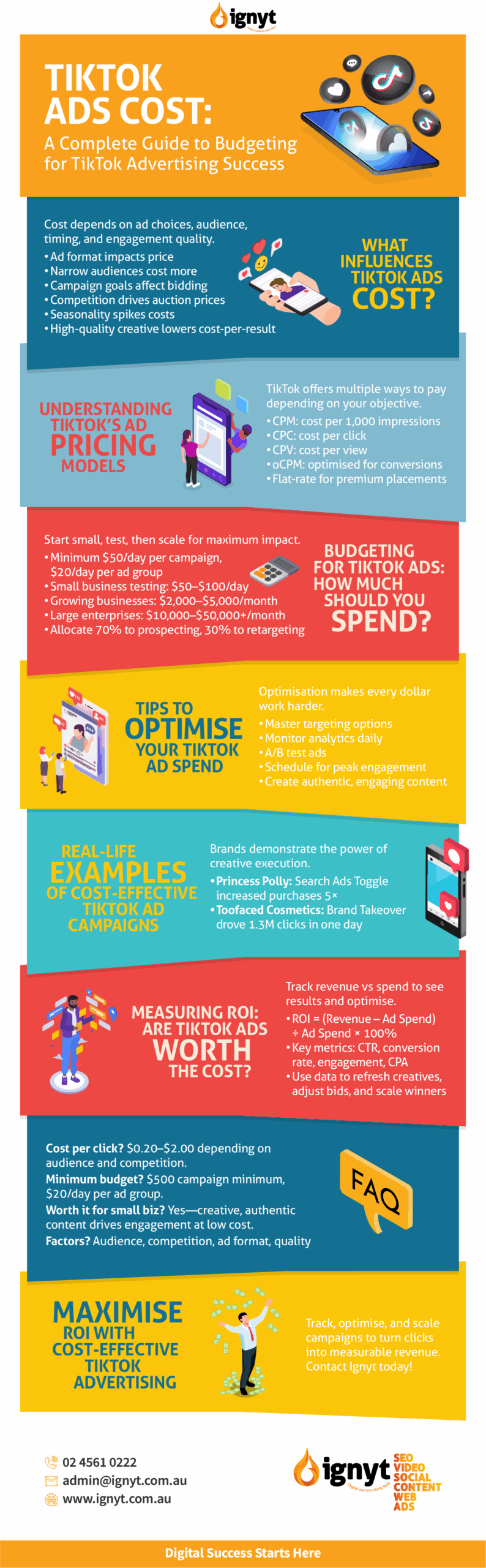
TikTok has minimum budget requirements to ensure campaigns have enough spend to generate data, requiring $50 at the campaign level and $20 at the ad group level per day.
This means you need to commit a reasonable amount to allow the algorithm to start optimising your ad delivery effectively.
So, how much do TikTok ads cost per month?
For small businesses in a testing phase, a starting budget of $50 – $100 per day for one or two weeks is a great way to learn what works without needing to break out the cheque book too much.
Remember the goal here is to collect data and find winning creatives and audiences.
For growing businesses ready to scale, a budget of $2,000 – $5,000+ per month allows you to invest in proven campaigns while continuing to test new ideas.
At this stage, a good rule of thumb is to allocate 70% of your budget to scaling what works and 30% to experimentation.
For large enterprises aiming to dominate the market, monthly budgets can easily exceed $10,000 – $50,000, supporting a multi-faceted strategy that includes always-on conversion campaigns alongside high-impact brand awareness efforts.
Smart Budgeting for TikTok Ads Cost
A smart budgeting strategy involves allocating spend across the marketing funnel to guide a customer from initial awareness to final purchase.
Consider dedicating the majority of your budget, around 70%, to prospecting.
This means reaching ‘cold’ audiences of new users at the top of the funnel who have likely never heard of your brand before.
This investment is your engine for long-term growth, as it constantly introduces your business to fresh potential customers.
The remaining 30% can then be strategically used for retargeting.
This focuses on the smaller, ‘warmer’ audience of users in the middle or bottom of the funnel who have already shown interest by visiting your website, watching a previous ad, or adding an item to their cart.
This two-part approach creates a powerful cycle.
The prospecting budget discovers new leads, and the highly-efficient retargeting budget works to convert that existing interest into sales.